Touching the Wounds of Christ
Discovering Hope for the World: Sister Ana María Pineda
Discovering Hope for the World: Sister Ana María Pineda
In San Francisco’s Mission District, prior to a devastating fire in 1997, the predominantly Latino parishioners of Saint Peter’s Church would pause before a large crucifix hanging in its vestibule. There, they would kiss the pierced feet of Christ so that over time the black enamel of the nail wore away, revealing the gold metal beneath.
In San Francisco’s Mission District, prior to a devastating fire in 1997, the predominantly Latino parishioners of Saint Peter’s Church would pause before a large crucifix hanging in its vestibule. There, they would kiss the pierced feet of Christ so that over time the black enamel of the nail wore away, revealing the gold metal beneath.
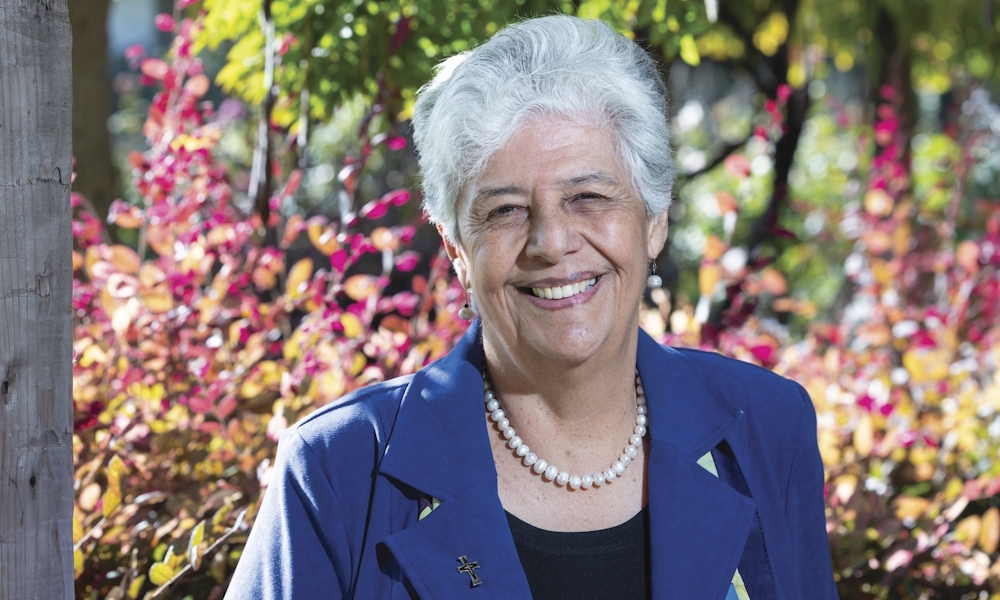
For Sister Ana María Pineda, this vivid memory of witnessing the simple act of reverence in her childhood impressed upon her an understanding of who Jesus is and of her own vocation. She understood that her role, and that of every Christian, is “to kiss the feet of a wounded world, and to try and console and transform that suffering into a resurrected joy that Jesus offers us.”
A Heart for Others from the Beginning
Sister Ana Maria began her vocation with the Sisters of Mercy as a teacher, where she discovered how much she could learn by simply sitting at the kitchen tables of her students’ families, listening as parents often related their hardships and their dreams.
She reflected, “I think that the memories of how those humble parents shared their sufferings with me in their own homes, in some way, keep drawing me back to the crucified figure of Jesus in Saint Peter’s Church vestibule.” Working with families from the beginning taught her the value of having a heart for others, like Christ who "lives in our homes and neighborhoods and suffers with us.”
Daughter of Immigrants
Born in El Salvador, Ana María arrived in the United States when she was two years old. Her family settled in San Francisco’s Mission District, which, Sister Ana recollected, “was like a small replica of what my parents had left behind in El Salvador.”
She recalled, “The devotions that were celebrated in Saint Peter’s appealed and reached out to the Latin American neighborhood and population. It was like the heart of that community. And all of that nurtured me.” Spanish was spoken in her home, although she admits, with a laugh, that she never speaks it perfectly. For her, the blessing of being bilingual “opened up a world I would never have understood or appreciated otherwise.”
Still, it was not until she returned to El Salvador at age fifteen that she felt the full force of belonging to her cultural roots. She shared how, as her Salvadoran relatives drove down the central boulevard of the country’s capital, San Salvador, during sunset, she was weeping openly. She described her feelings at that moment: “It was as if I was being welcomed back into the womb of the country. I cried and cried.”
Daughter of the Encuentros: Building Hispanic/Latino Ministry
From very early on, Sister Ana María understood her calling to be wholly committed to serving the Latino community. She found herself deeply touched by the documents and reforms of the Second Vatican Council, the Latin American bishops’ gatherings at Medellín and Puebla [see sidebar] and her involvement in grassroots movements like the Movimiento Familiar Cristiano, a national lay Catholic movement supporting families.
This grassroots work fed directly into the Encuentros, the historic gatherings of Hispanic Catholics that shaped Latino ministry in the United States. Sister Ana María was present at the Segundo Encuentro (Second Encounter) in 1977, where she helped compile the reflections of parish groups and sent them to Washington, D.C., to the United States Conference of Catholic Bishops (USCCB).
“I was really blessed — along with some of my other beautiful friends and colleagues — to have been part of the very beginning of the Catholic Church's attention to Hispanic Catholics in the United States, which goes all the way back to 1972, roughly.” She would go on to participate in the third, fourth, and fifth Encuentros, helping the Church learn “on its feet” how to accompany the nation’s fastest-growing Catholic population. Since that time, her community involvement and expertise have contributed to shaping national outreach to Hispanic Catholics.
A Most Exciting Time in the New Diocese of San José
When the Diocese of San José was founded in 1981, Sister Ana María was invited by Bishop Pierre DuMaine to help lay its foundations. She, Sister Gloria Loya, and a dedicated team established the Centro Pastoral at Our Lady of Guadalupe Church in San José, a hub for Hispanic ministry. Sister Gloria and Sister Ana María were the co-directors of the office.
“We were responsible for trying to nurture, foster, and encourage Hispanic ministry in the new diocese, and it was an exciting time because we were starting afresh.” She and Sister Gloria visited pastors responsible for parishes with large Latino or Hispanic populations. "We listened to their needs to learn how we could help them.”
They launched educational programs for lay leaders, the forerunners of the current Diocesan Institute for Leadership in Ministry. Many of those early participants tell Sister Ana María that their certificates still hang on their walls, decades later. Looking back, she sees those early efforts as forerunners of the Church’s current call to synodality: listening first, then responding together.
Family Ties to a Martyr
Sister Ana María's family holds a connection to El Salvador’s most turbulent chapter, as the niece of Father Rutilio Grande, the Jesuit priest assassinated in 1977 for his outspoken defense of the poor. His martyrdom profoundly influenced Archbishop Óscar Romero.
During her time investigating the life of Father Grande, Sister Ana María had the opportunity to meet Saint Archbishop Óscar Romero himself. Her book, Romero and Grande, Companions on the Journey (2016), is the fruit of her research. She continues to be actively involved with organizations that advocate for those on the margins of society in El Salvador.
Personal Recognition and the Suffering Christ and the World
This year, she is beginning her 28th year as an associate professor of Theology at Santa Clara University. Though the impact of her ministry is far-reaching, she insists they return to the same center: the crucified Christ of her childhood parish. “That figure was no longer just a personal devotion,” she explains. “It became a lens through which I saw the struggles of the poor, the cries of migrants, the injustices in my homeland and beyond.
“But the other part of it is, it is not just the crucified figure; it is also the resurrected Jesus, because I have been able to enter into the joys of people's accomplishments and what they have overcome through their hard work." Her own recent recognition [see sidebar 2], she insists, is less about her personal accomplishments than about the people and experiences that shaped her. "Nothing that we achieve is done by ourselves: it’s a communal effort.”
She continued, “And I think it also points to the deep sense of community that, as Latinos, is part of who we are. We do things as a family.” She attributes this spirit of gratitude to her parents, who modeled a life of thanksgiving. “My father and mother were always grateful to God,” she recalled. “They taught me that even in difficulty, gratitude opens the way to grace.”
Looking back, Sister sees her life as a gift, marked by God’s abundance, perhaps the gold beneath the hard parts of her journey, like the gold that lay beneath the enamel of the nail of the crucified Christ. “My journey began at the foot of a crucifix in a small San Francisco parish,” she reflected. “It continues in classrooms, conferences, and living rooms, wherever I listen and walk with others. It grew to embrace the greater needs of a suffering world that called me to kiss the wounded feet of the Crucified Jesus, and it now embraces the needs of the global community.”
Latin American bishops’ gatherings at Medellín and Puebla
The Medellín or Second Episcopal Conference of Latin America (1968) and Puebla (1979) gatherings were significant conferences of the Latin American Church that applied the teachings of the Second Vatican Council to the region.
Sister Ana Maria’s 2025 Local and National Recognition
- The Encuentros Award, USCCB, November 13, 2024: “This award is the highest recognition given by the Subcommittee on Hispanic Affairs for a sustained and significant contribution to the development and accompaniment of Hispanic/Latino Ministry at the national level over the years.”
- Honorary Doctorate, Misericordia University, Dallas, PA, May 10, 2025: Conferred “upon Ana Maria Pineda, RSM, STD, a distinguished theologian, educator, and pioneer in Hispanic ministry and theology in the United States. For decades, Sister Ana Maria has worked to uplift Hispanic/Latino voices in the Catholic Church and to shape pastoral practices rooted in culture, justice, and faith.”
- CRISPAZ (Christians for Peace in El Salvador) [October 15, 2025] honored Sister Ana María Pineda, RSM, with their annual Peter Hinde CRISPAZ Peace Award for her lifelong dedication to the ministry to the Latino/a community and her ongoing efforts to preserve the memory and legacy of the Martyrs of El Salvador. CRISPAZ’s work builds bridges of solidarity between communities in the global north and El Salvador. They continue to inspire efforts toward justice, peace, and reconciliation.
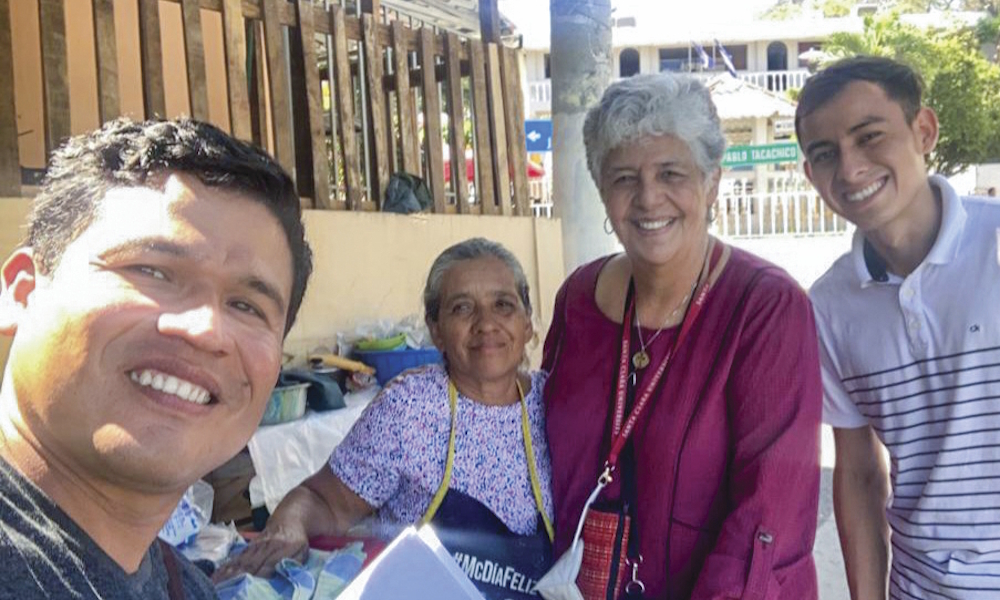
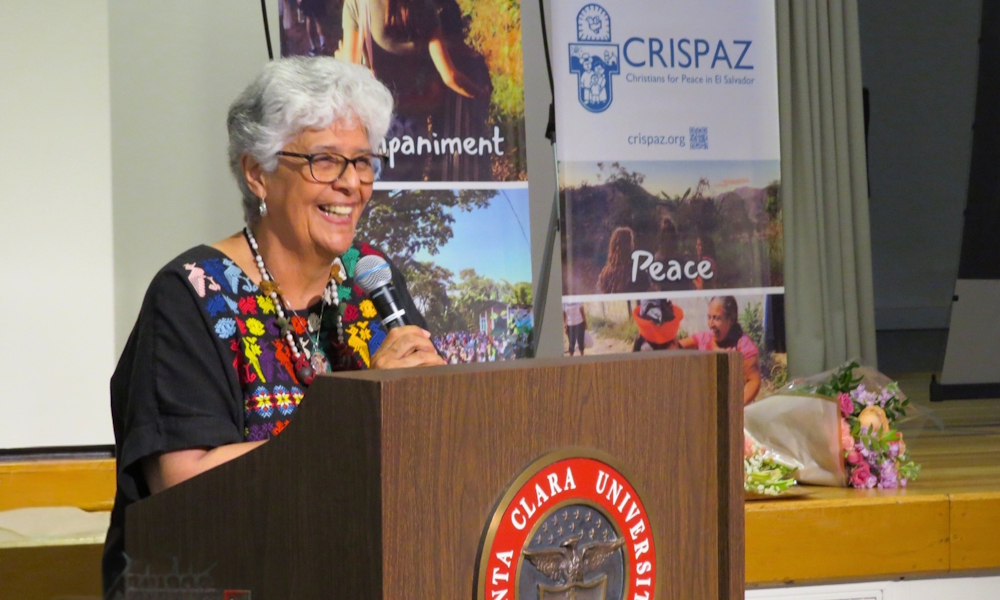

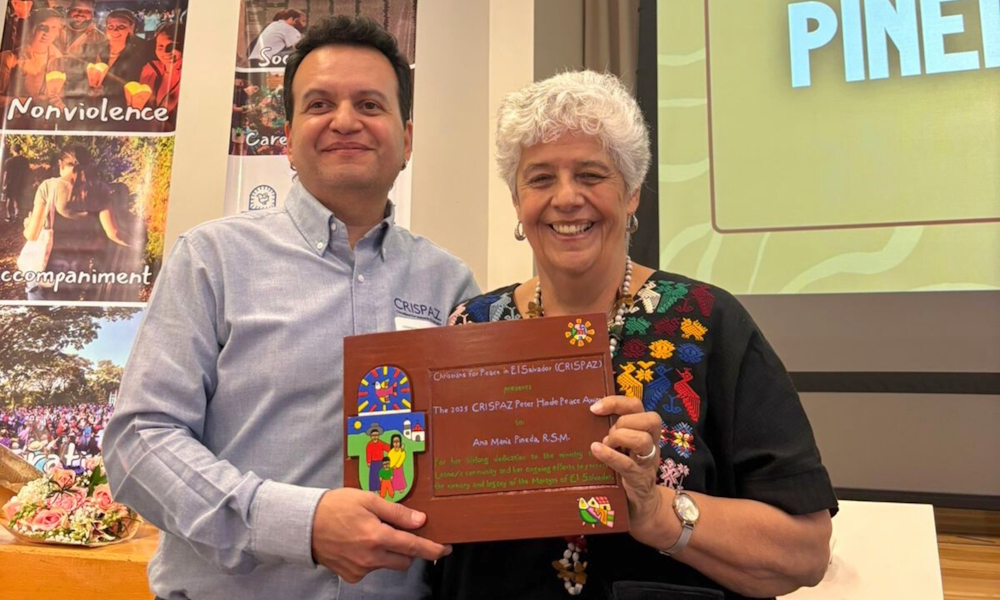
Sr. Ana Maria Pineda is a Sister of Mercy and an Associate Professor of Theology at Santa Clara University. She is a widely published, nationally and internationally recognized figure whose work continues to impact Latino ministry in the United States. Internationally, she continues efforts to preserve the memories of the martyrs of El Salvador.