
Working against Human Trafficking: Felicitas Onetti
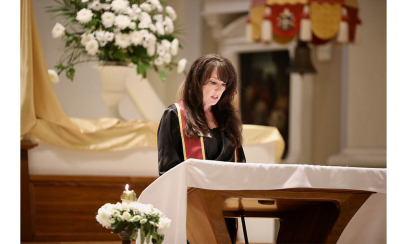
In 2026, the South Bay will host several national and international sporting events: the Super Bowl, the NBA Regional March Madness Finals, and FIFA World Cup games. These events are often associated with increased human labor and sex trafficking. Felicitas Onetti, Anti-Trafficking Education and Outreach Coordinator in Migration and Refugee Services at the United States Conference of Catholic Bishops (USCCB), was invited by the Diocese of San José to share how her Catholic faith inspires her work to combat this issue.
In 2026, the South Bay will host several national and international sporting events: the Super Bowl, the NBA Regional March Madness Finals, and FIFA World Cup games. These events are often associated with increased human labor and sex trafficking. Felicitas Onetti, Anti-Trafficking Education and Outreach Coordinator in Migration and Refugee Services at the United States Conference of Catholic Bishops (USCCB), was invited by the Diocese of San José to share how her Catholic faith inspires her work to combat this issue.
Long before she knew she would one day steward the U.S. Bishops’ anti-trafficking work, Felicitas Onetti was convinced of one truth: “I just really understood that the face of Christ was always with the needy.” For her, through the years, Jesus was and continues to be present in the faces of those who are vulnerable to exploitation.
A Catholic Approach to Sporting Events
Even while enjoying sporting events, Catholics are called to acknowledge and work for justice for those who are at risk of becoming victims. Felicitas explained, “At the celebrations of the games, when we see a lot of sex trafficking victimization and then when we see kind of contract workers on the forced labor side, because human trafficking is both.”
For large gatherings, unsuspecting people are often recruited for jobs with little compensation while working long hours. This is contrary to Catholic Social Teaching, as is its more sinister counterpart, sex trafficking. In all cases, the Church upholds the dignity of the human person so that no one is ever reduced to a mere object or commodity.
A Catholic’s first step is learning about these realities and making them known. This is why Father Michael Carson, interim Diocesan Director of the Office of Life, Justice, and Peace, invited Onetti to speak at Santa Clara University in February of 2026. “Being able to educate one another, I think spreading awareness is a key component of some of the work that the USCCB does, and this always aligns with Catholic social teaching,” Felicitas offered.
Father Michael commented on both her work and the United States Bishops making the issue a priority: “One of the most important aspects of Catholic Social Justice is caring for the dignity of each person. Felicitas has been at the forefront of the Catholic Bishops’ response, especially in motivating Catholic leaders to work not only in stopping human trafficking, but also in the care of its victims. The bishops throughout the United States have seen the attack on that dignity through the sin and evil of human trafficking and are united in condemning it.”
A Ministry that Led to a Return to Faith
Felicitas was raised Catholic, but her early advocacy as a teen and beyond eventually led her to deepen her appreciation of her faith as an adult. “I was first introduced to human trafficking growing up in high school, where I worked in a club called SALTT (Service and Leadership of Today and Tomorrow), which partnered with migrant farmworkers and their families. This allowed me to work through a Catholic lens of serving the poor.”
She felt she truly encountered Jesus in the face of the poor, “particularly in the migrant.” Working with migrants is where she first experienced forced labor practices and the inhumane treatment of vulnerable populations. Later on in her career, she also worked in prisons. Repeatedly, as she encountered desperate circumstances, she was brought back to the following conviction, “There's no doubt that Christ is there with those who suffer.”
Working for Justice, Accompanying Survivors
“Catholics have a critical role in this mission, in this fight against trafficking. We need to remind society and victims that they are endowed with dignity, that they are more loved than they often realize, and that they are called to more.” Felicitas encourages all those of good faith to look at people through the eyes of Christ and to get involved at the local level, if possible.
Overseeing the USCCB Anti-trafficking Program for her, “has been the greatest gift the Lord has given me to serve the poor in this topic, as it relates to almost every group, across every race, ethnicity, internationally, domestically, and across many sectors of social work.” She is quick to emphasize that the true heroes are those whom she serves, including survivors. “Accompanying survivors is a true gift; survivors are out there trying to help the victims at any given moment. I like to say: this is not about me, but about them.”
For Felicitas, who is about to be married and begin a new chapter in life, gratitude for this ministry permeates her life. “My love for the poor is grand, and I believe that it will continue as I step into my new vocation as a wife. I know my spouse, and I will continue to serve the poor and share in this mission of the Gospels. Christ made me an instrument to serve the poor in a way I never could have imagined. It has transformed my faith life and sense of purpose.”
Learn more about the USCCB Anti Trafficking programs here: https://www.usccb.org/topics/anti-trafficking-program
Based in Washington, D.C., Felicitas serves as the Anti-Trafficking Education and Outreach Coordinator for the Migration and Refugee Services Department at the United States Conference of Catholic Bishops (USCCB). Her experience includes migration, substance use disorders, child welfare, prison reentry, and anti-trafficking.